US Supreme Court Tariff Ruling 2026: Impact on US Economy, India, and Bilateral Trade Relations
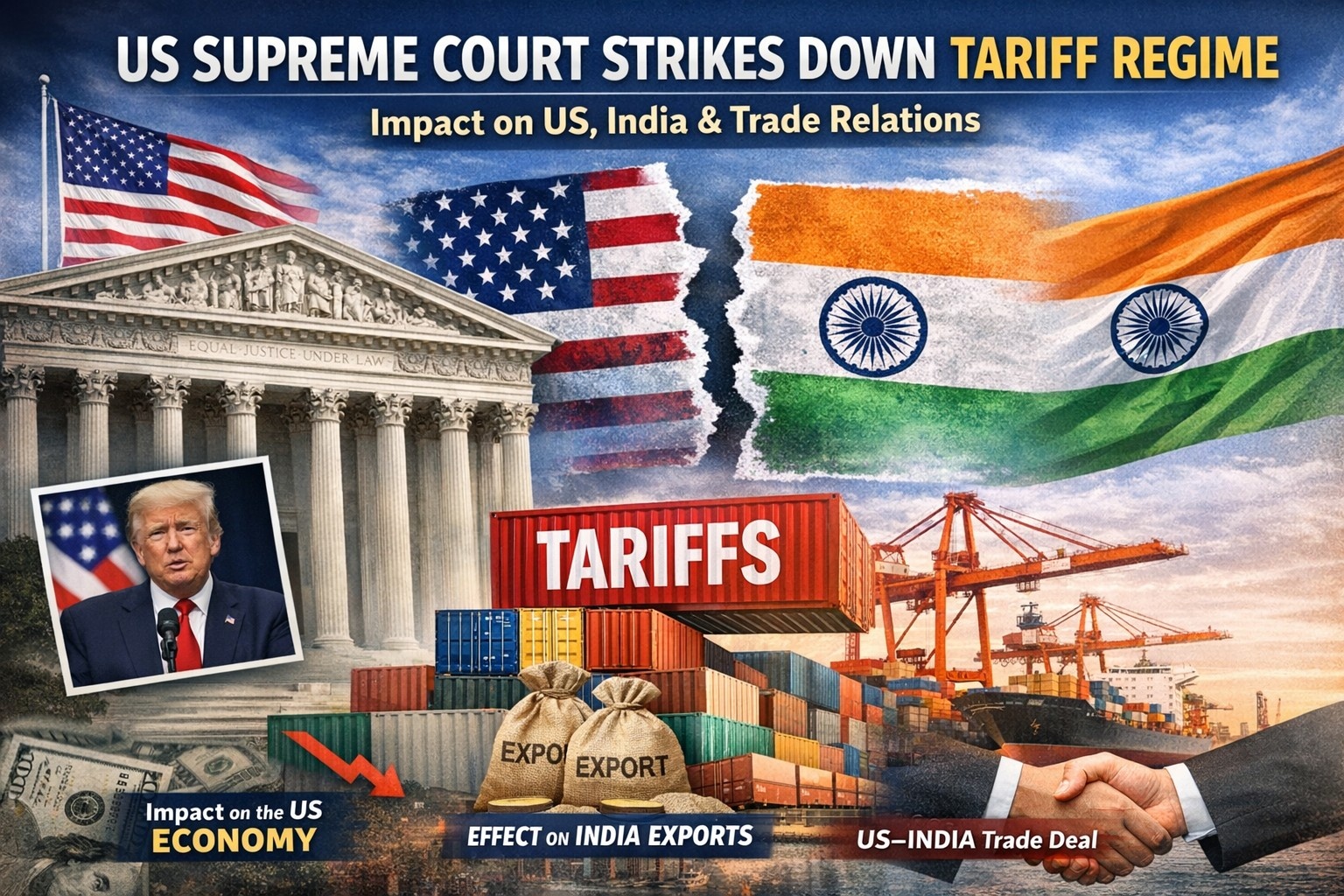
In a landmark decision, the Supreme Court of the United States ruled 6–3 against former President Donald Trump’s sweeping global tariff program, holding that the President did not have the authority to impose broad tariffs on imports using emergency powers under the International Emergency Economic Powers Act (IEEPA).
The Court clarified that the constitutional power to regulate foreign commerce, including imposing tariffs, rests with the U.S. Congress—not the Executive branch. This ruling has significant legal, economic, and geopolitical implications, especially for countries like India that were affected by the tariff measures.
Background of the Case
The dispute centered on the use of IEEPA, a law designed to give the President authority during national emergencies. The Trump administration had used this law to justify imposing wide-ranging reciprocal tariffs on imports from multiple countries.
However, the Court ruled that IEEPA does not grant unlimited authority to impose blanket tariffs and that such trade measures require clear congressional authorization.
Importantly, the judgment does not affect tariffs imposed under other statutory provisions, such as Section 232 of the Trade Expansion Act (national security-based tariffs on steel and aluminum).
Key Takeaways from the Ruling
- Presidential authority on trade is limited. Broad tariff measures require Congressional approval.
- Tariffs imposed under IEEPA are invalidated.
- Section 232 tariffs on steel, aluminum, and certain auto components remain in effect.
- The issue of refunding previously collected tariffs remains legally uncertain and may be decided in lower courts.
- The administration has introduced a temporary 10% tariff under Section 122 of the Trade Act of 1974 for a limited duration, creating a transitional framework.
Impact on the United States
1. Constitutional and Political Impact
The ruling reinforces the separation of powers by restoring Congress’s central role in trade policy. It limits the Executive branch’s unilateral power in imposing large-scale tariffs.
2. Revenue Uncertainty
The earlier tariff regime generated substantial revenue for the U.S. government. If courts mandate refunds for previously collected duties, it could create fiscal and administrative challenges.
3. Market Stability
Financial markets reacted positively to the decision, as it reduces uncertainty around aggressive tariff expansion. Businesses may experience more predictable trade policy moving forward.
4. Industry-Level Impact
Industries that benefited from protective tariffs could face increased competition from foreign imports. Conversely, import-dependent industries may benefit from reduced input costs.
Impact on India
India was among the countries affected by the broad reciprocal tariffs. The Supreme Court decision provides both relief and new strategic considerations.
1. Reduction in Tariff Burden
A significant portion of Indian exports to the U.S., which were previously subject to higher reciprocal tariffs, may now revert to standard Most Favoured Nation (MFN) rates. This enhances competitiveness for Indian exporters.
2. Section 232 Tariffs Continue
Exports such as steel and aluminum continue to face national security-based tariffs. Therefore, the relief is partial, not complete.
3. Potential Refund Claims
Indian companies that paid tariffs under the invalidated regime may seek refunds. However, the legal process could be lengthy and uncertain.
4. Strategic Trade Reassessment
India may reconsider aspects of its interim trade negotiations with the U.S., as the tariff structure underpinning certain concessions has now changed.
Impact on US–India Trade Relations
1. Interim Trade Framework Affected
An interim understanding between the U.S. and India involved tariff adjustments on both sides. With the Court invalidating a major part of the U.S. tariff framework, the basis of some negotiated terms may require review.
2. Increased Negotiating Space for India
With broad reciprocal tariffs struck down, India may have stronger leverage in negotiating a more balanced bilateral trade agreement.
3. Temporary Tariff Environment
The new temporary 10% tariff creates short-term uncertainty. Businesses on both sides may adopt a cautious approach until a long-term trade policy framework is clarified.
4. Long-Term Bilateral Trade Outlook
In the long run, the ruling could lead to more stable, rules-based trade relations between the U.S. and India, provided both countries move toward a comprehensive bilateral trade agreement.
Conclusion
- The decision of the Supreme Court of the United States marks a significant shift in U.S. trade governance. By reaffirming Congressional authority over tariffs, the Court has reshaped the legal landscape of American trade policy.
- For the United States, the ruling restores constitutional balance but introduces short-term uncertainty regarding refunds and temporary tariffs. For India, it provides partial tariff relief and opens space for renegotiation of trade terms.
- The ultimate impact on US–India trade will depend on how both governments respond—whether through legislative action, renegotiated agreements, or a broader push toward a formal bilateral trade framework.