Thematic Mutual Funds: Meaning, Types, Benefits and Investment Strategy
Introduction
Mutual funds have evolved significantly over the years to meet the diverse investment needs of investors. While traditional diversified equity funds invest across sectors to reduce risk, some investors prefer strategies that allow them to participate in specific long-term economic trends. This is where Thematic Mutual Funds play an important role.
Thematic mutual funds are designed to capitalize on powerful structural changes in the economy, such as technological innovation, infrastructure development, energy transition, financial inclusion, or rising consumer demand. These funds aim to capture growth opportunities that arise from these macroeconomic shifts.
Unlike diversified equity funds, thematic funds follow a focused investment approach, investing in companies that are closely connected to a particular economic theme. Because these funds concentrate on a specific idea or trend, they offer the potential for higher returns when the theme performs well, but they also carry higher risk and volatility.
Understanding how thematic mutual funds work, their advantages, risks, and their role in portfolio construction is essential for investors who are considering theme-based investing.
What Are Thematic Mutual Funds?
Thematic mutual funds are equity-oriented funds that invest in companies linked to a particular investment theme or long-term economic trend. A theme represents a structural development in the economy that is expected to drive growth across multiple industries over time.
Instead of focusing on a single sector, thematic funds identify companies that benefit from the broader theme, even if those companies operate in different industries.
For example, a digital transformation theme may include:
- IT service providers
- Fintech companies
- Cloud infrastructure providers
- Digital payment platforms
- Telecom and data infrastructure firms
All these companies contribute to or benefit from the same theme even though they belong to different sectors.
The performance of a thematic fund depends largely on the success and growth of the underlying theme over the investment horizon.
Key Characteristics of Thematic Mutual Funds
1. Theme-Based Investment Strategy
The core idea behind thematic funds is to capture the growth potential of a specific economic or technological trend. The fund manager selects companies that are expected to benefit from the development of that theme.
2. Multi-Sector Exposure
Unlike sector funds, thematic funds may invest across multiple industries if those industries contribute to the same theme.
3. High Conviction Portfolio
Thematic funds often contain a relatively concentrated portfolio of companies strongly aligned with the theme.
4. Active Fund Management
Most thematic funds are actively managed, meaning fund managers continuously research industries, analyze company fundamentals, and adjust the portfolio based on market developments.
5. Long-Term Investment Horizon
Themes usually unfold over several years. Therefore, thematic funds are generally suitable for investors with a long-term investment perspective.
Popular Investment Themes in Thematic Funds
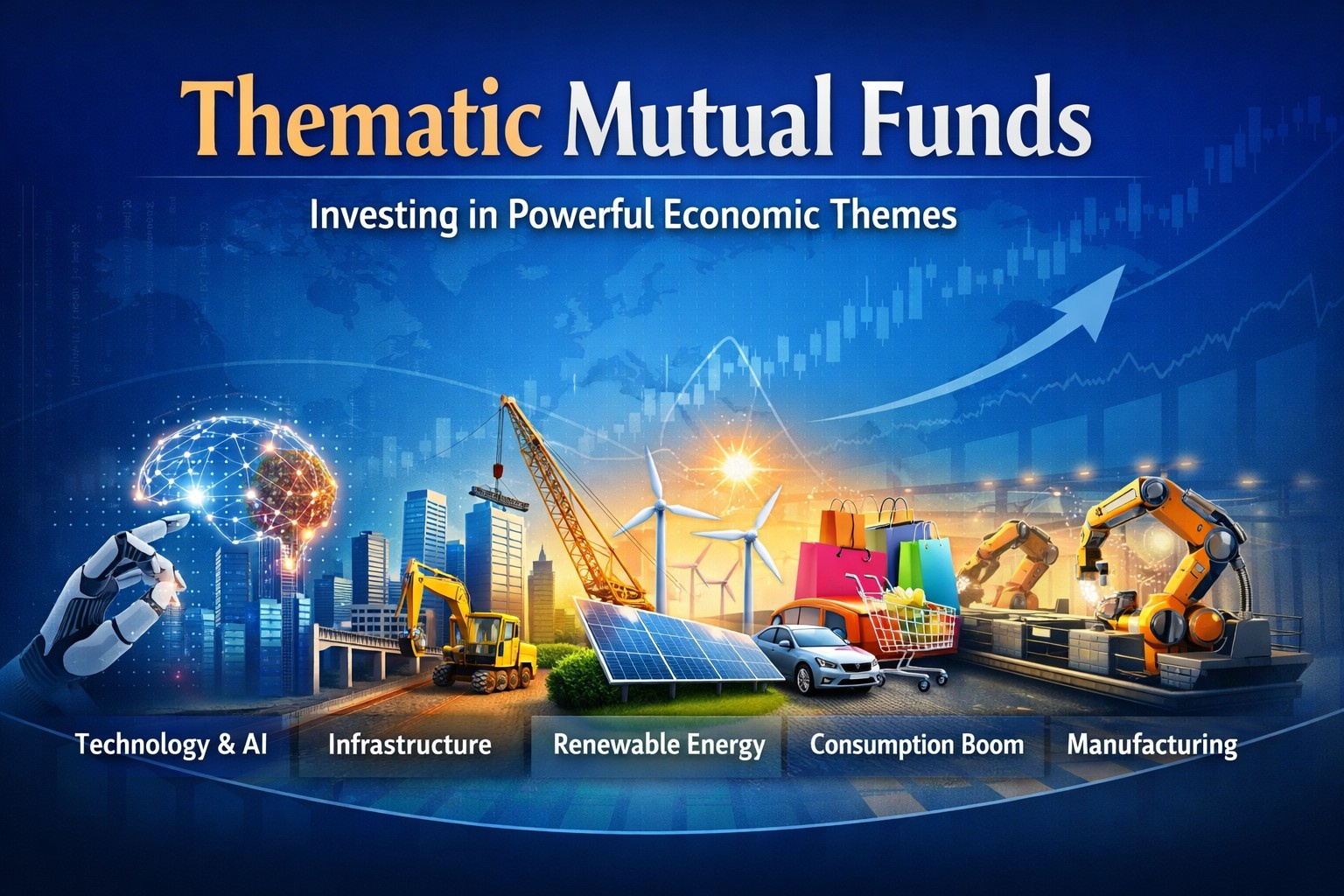
Thematic funds typically focus on major structural trends shaping the global and domestic economy. Some commonly observed themes include:
1. Infrastructure Development
Infrastructure development is one of the most significant drivers of economic growth, particularly in emerging markets like India. Governments invest heavily in roads, railways, ports, airports, energy systems, and urban development.
Infrastructure thematic funds may invest in companies such as:
- Engineering and construction firms
- Cement and steel manufacturers
- Capital goods companies
- Power generation and transmission companies
- Logistics and transportation businesses
These companies benefit directly from increased infrastructure spending and large-scale development projects.
2. Technology and Digital Transformation
The rapid adoption of digital technologies has created one of the most powerful investment themes globally. Businesses across industries are integrating technologies such as artificial intelligence, cloud computing, cybersecurity, and automation into their operations.
Technology-themed funds may include investments in:
- IT services companies
- Software development firms
- Data analytics and cloud computing providers
- Semiconductor manufacturers
- Digital platform companies
As digitalization accelerates globally, this theme continues to offer significant long-term growth potential.
3. Consumption and Rising Middle Class
Rising income levels and urbanization in developing economies are creating strong demand for consumer goods and services. The consumption theme focuses on companies benefiting from increasing spending power among households.
Companies within this theme may include:
- FMCG companies
- Retail chains
- Automobile manufacturers
- Consumer electronics companies
- Hospitality and travel companies
The expansion of the middle class in countries like India makes this theme particularly attractive for long-term investors.
4. Energy Transition and Sustainability
With growing concerns about climate change and environmental sustainability, the global economy is gradually transitioning toward cleaner energy sources.
Energy transition thematic funds may invest in:
- Renewable energy companies (solar, wind, hydro)
- Electric vehicle manufacturers
- Battery technology companies
- Energy storage providers
- Green hydrogen and clean fuel companies
Governments and corporations worldwide are investing billions into sustainable energy solutions, making this one of the most significant long-term investment themes.
5. Manufacturing and Industrial Growth
In recent years, many countries have focused on strengthening domestic manufacturing capabilities to reduce supply-chain dependencies. Government initiatives promoting local manufacturing can create strong growth opportunities for companies in this sector.
Manufacturing-themed funds may invest in:
- Industrial equipment manufacturers
- Auto component suppliers
- Electronics manufacturing firms
- Defense and aerospace companies
- Chemical and specialty material producers
Difference Between Thematic Funds and Sector Funds
Although thematic funds and sector funds appear similar, they differ in structure and diversification.
| Feature | Sector Funds | Thematic Funds |
|---|---|---|
| Investment Focus | Single sector | Broad economic theme |
| Diversification | Limited to one industry | Multiple sectors |
| Risk Level | High | Moderate to High |
| Example | Banking Fund | Digital Economy Fund |
For instance, a banking sector fund invests only in banks and financial institutions. A financial inclusion theme, however, may include banks, fintech companies, insurance providers, and digital payment platforms.
Advantages of Thematic Mutual Funds
1. Exposure to Long-Term Structural Growth
Thematic funds allow investors to benefit from major economic transformations that may shape markets for decades.
2. Potential for Higher Returns
If the chosen theme performs well, the fund may generate significant returns compared to broader market indices.
3. Strategic Investment Approach
These funds allow investors to align their portfolios with future economic trends and technological innovation.
4. Diversification Across Industries
Although focused on a theme, investments may span multiple sectors, offering broader exposure than a pure sector fund.
Risks of Thematic Mutual Funds
Despite their growth potential, thematic funds involve several risks.
1. Concentration Risk
Because the portfolio is centered around a specific theme, underperformance of that theme can significantly impact returns.
2. Economic Cycles
Certain themes perform well only during particular economic cycles. When market conditions change, returns may decline.
3. Timing Risk
Investors who enter a thematic fund after the theme becomes popular may experience lower returns due to overvaluation.
4. Higher Volatility
Thematic funds may experience larger fluctuations compared to diversified equity funds.
Role of Thematic Funds in Portfolio Allocation
Financial advisors generally recommend using thematic funds as satellite investments within a broader portfolio.
A typical investment structure may include:
- Core Portfolio: Diversified equity funds and index funds
- Satellite Allocation: Sector funds or thematic funds
- Experts often suggest limiting thematic fund allocation to 10–15% of the total investment portfolio to manage risk effectively.
How to Choose the Right Thematic Fund
Before investing in a thematic fund, investors should evaluate several factors:
1. Strength of the Theme
The theme should be supported by long-term economic drivers, not short-term market hype.
2. Fund Manager Expertise
The ability of the fund manager to identify companies that genuinely benefit from the theme is crucial.
3. Portfolio Composition
Investors should examine whether the portfolio contains companies that are strongly aligned with the theme.
4. Investment Horizon
Since themes take time to develop, investors should be prepared to remain invested for several years.
Final Thoughts
Thematic mutual funds offer investors an opportunity to participate in some of the most powerful forces shaping the global economy. By focusing on structural trends such as digital transformation, energy transition, infrastructure development, and consumption growth, these funds aim to capture long-term value creation.
However, due to their concentrated nature and higher volatility, thematic funds should be approached with careful analysis and a disciplined investment strategy. They work best when used as a complement to a diversified portfolio rather than a primary investment vehicle.
For investors with a strong conviction about specific economic trends and a long-term investment horizon, thematic mutual funds can provide a compelling way to align investments with the future direction of markets and industries.